Latest nearby
—
Real-time earthquake monitoring, plain-language safety guidance and local emergency resources — built so every household in Nepal can act faster and stay safer.
Recent earthquake activity in and around Nepal, cross-checked live against USGS and EMSC.
Live data cross-checked from USGS and EMSC. Official Nepal records: National Seismological Centre.
Earthquakes can't be predicted. Readiness is what saves lives. EQ Sentry turns raw seismic data into action.
Real-time earthquakes across Nepal and the Himalaya from USGS, plus the full local catalogue since 1911.
Open →Clear steps for before, during and after a quake, an emergency-kit checklist and a family plan.
Open →Register your district to be notified about significant earthquakes near you.
Open →Nepal's emergency numbers, hospitals and the official agencies you can rely on.
Open →Nepal lies where the Indian plate pushes beneath the Himalaya. Roughly two centimetres of convergence across the range each year builds strain where the fault is locked, making Nepal highly earthquake-prone.
The 2015 Gorkha earthquake (M7.8) killed close to 9,000 people. The 1934 Nepal–Bihar quake (M8.0) was larger still. Scientists warn strain keeps building, especially in the west. Preparation is the one thing fully within our control.
Years of loading and seconds of rupture use different playback time scales.
Movement is exaggerated in a fixed frame; hollow markers show initial positions.
India moves slowly beneath the Himalaya. Friction holds part of the Main Himalayan Thrust in place, so the surrounding rock deforms and stores strain.
Schematic views. Geometry, movement and time are simplified; the sequence is slowed for clarity.
Science: USGSReduced motion: select a stage to explore.
Eight defining events, from the 1934 Nepal–Bihar disaster to the 2025 Dingri quake.
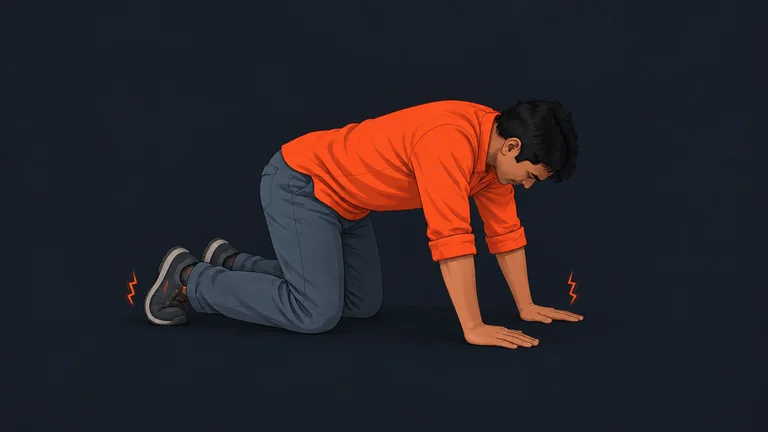
Drop to your hands and knees before the shaking knocks you down.
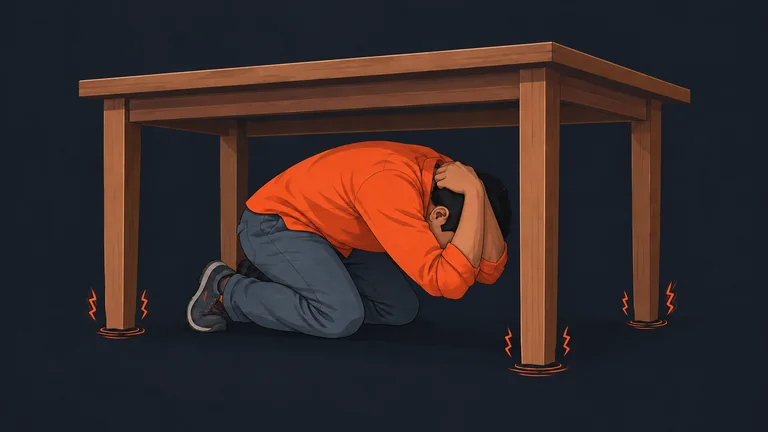
Take cover under a sturdy table; protect your head and neck.
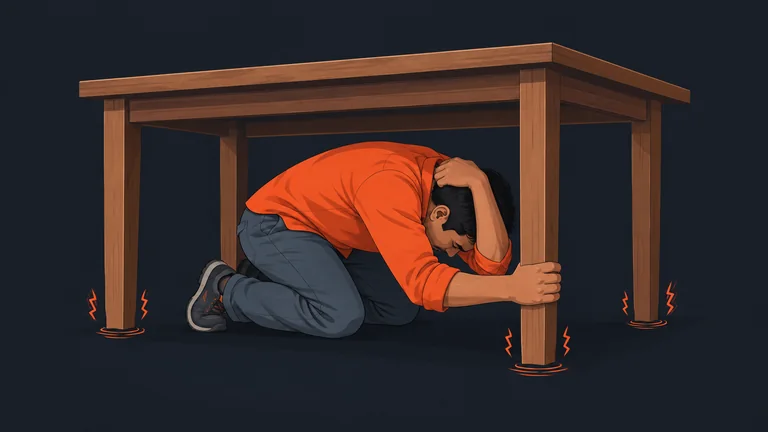
Hold on to your shelter until the shaking stops completely.
Register for alerts and keep your household plan close. Two minutes today can save lives tomorrow.